
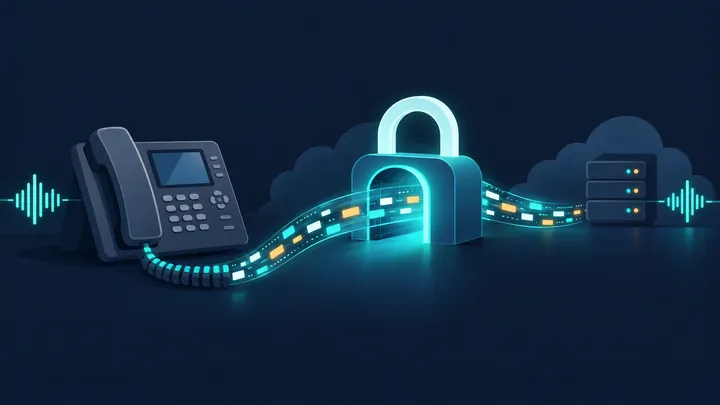
Your VoIP encryption setting can be enabled while part of a call still travels unprotected. A handset's padlock doesn't tell you what happens after the call reaches a gateway. Say a dental clinic in Leeds has 40 handsets and takes appointment calls containing patient details. Its phones might protect call setup while sending ordinary voice packets. Treating encryption as a property of each connection, rather than the whole phone system, gives you a testable plan. You'll know where protection starts, where it ends, and which exceptions still need attention.
Signalling and media need separate protection
Call setup and spoken audio follow different paths. Securing one doesn't secure the other, so a successful encrypted registration isn't evidence that your conversation is private.
In the Leeds clinic example, the handset could use Transport Layer Security (TLS) for Session Initiation Protocol (SIP) messages to its call manager. The audio could still use unencrypted Real-time Transport Protocol (RTP). A session border controller (SBC), which manages calls crossing network boundaries, might also terminate TLS and create a separate onward connection.
A route diagram with separate signalling and media lines exposes that gap. Each line needs its own protection requirement and termination point. TLS protects SIP transport; Secure RTP (SRTP) protects media when encryption is negotiated. A decrypting SBC remains a trusted system, and a traditional telephone-network leg isn't covered by SRTP.
VoIPshield is an Ottawa-based VoIP security company whose VoIPaudit assesses VoIP call-manager vulnerabilities and supports compliance reporting. That assessment complements encryption testing; it doesn't replace proof that media is protected. The VoIP security primer provides context for controls beyond encryption.
SRTP compatibility includes the key exchange
Two devices can both support SRTP and still fail to establish protected audio. The media cipher and the way devices obtain matching keys are separate compatibility questions.
Say an Ottawa distributor adds remote softphones for 12 sales staff. Its phones offer one keying method, while its trunk accepts another. Calls might fail, produce silence, or fall back to clear media if policy permits it.
IETF RFC 3711 (2004) specifies SRTP confidentiality, message authentication and replay protection. It doesn't define a single mandatory key-exchange workflow. Recording the supported keying method and cryptographic profile for each endpoint pair therefore catches incompatibilities that an 'SRTP supported' checkbox misses.
Wikipedia's ZRTP entry (accessed 2026) describes Diffie–Hellman key agreement over the media path, independent of SIP signalling, with SRTP carrying encrypted media. Users can compare a short authentication string to authenticate the exchange. ZRTP isn't a universal replacement: both endpoints need support, and users need an authentication procedure. Where keys travel inside signalling instead, protecting every signalling leg matters because exposed keys defeat media confidentiality.
Capacity problems can look like encryption problems
Enabling protection can reveal limited processing headroom or break an existing media service. But encryption doesn't automatically mean poor audio. RFC 3711 includes low computational cost among SRTP's design goals.
Say a Manchester retailer handles 90 simultaneous calls during a sale. Its SBC decrypts media for recording, converts codecs, then encrypts the outgoing stream. A quiet test call won't reveal whether that processing path can handle the sale's peak.
A before-and-after load test on the same call route separates capacity trouble from negotiation trouble. The useful measurements include SBC CPU, active sessions and call failures, alongside packet loss and jitter, the variation in packet arrival time. Call-setup duration deserves a separate check because TLS negotiation and certificate failures affect setup rather than audio payload processing.
There's no useful universal percentage for the CPU penalty. Hardware acceleration and transcoding change the result. Comparing the encrypted workload with your actual peak gives you a defensible capacity limit. Recorders and analytics also need an approved access path; disabling encryption across the fleet to restore recording creates a much larger exposure.
A staged rollout keeps exceptions visible
A fleet-wide change combines certificate failures with media mismatches, making faults harder to isolate. An indefinite 'prefer encryption' policy creates a different problem: successful calls may conceal silent fallback.
Say a Bristol legal practice has desk phones, home workers and a call recorder. The desk-phone pilot succeeds, but transferred calls to home workers lose audio. Declaring the deployment complete would miss the route that changed during transfer.
A staged plan gives each failure a smaller search area:
- A baseline records current routes, peak demand and certificate trust. Known behaviour makes later changes comparable.
- A small pilot enables TLS with certificate validation, then SRTP with matching keying settings. Separate changes make diagnosis easier.
- Feature testing covers transfers, conferences, recording and failover. These operations can introduce new media legs.
- Expansion makes encryption mandatory on validated routes. Explicit, time-limited exceptions keep incompatible devices visible.
You'll want rollback criteria tied to failed calls and capacity limits, with an owner for every exception. A rollback shouldn't become an undocumented permanent downgrade. Sensitive routes can fail closed while an approved alternative handles availability.
Packet captures need positive evidence
A port number or unreadable packet payload isn't proof of encryption. Capture tools can fail to play ordinary RTP because they lack a codec or missed part of the stream.
Say the Leeds clinic checks a dummy appointment call after rollout. Capturing only beside the handset could miss clear media leaving the SBC for the provider. The capture location defines what the result proves.
An authorised test with synthetic speech protects patient privacy. Captures on both sides of each encryption-terminating device, matched to endpoint logs, give you evidence for each leg:
- Signalling shows a completed TLS handshake and encrypted application traffic, rather than readable SIP messages. Endpoint logs confirm certificate validation; the capture alone doesn't prove it.
- Negotiation records show the selected SRTP profile and successful protected-media processing. Cleartext RTP playback without supplied keys would expose a failure.
- Media inspection checks both directions and repeats after transfer or failover. RFC 3711 leaves base RTP headers visible, so recognisable headers don't mean the voice payload is clear.
SRTP also permits a NULL cipher, which leaves payloads unencrypted. Confirming a non-NULL cipher prevents a misleading 'SRTP active' result. Failure to replay the capture isn't sufficient by itself. Captures and exported keys need restricted access and short retention.
A verified route is the acceptance test
Configuration evidence ages when routes change. Say the Bristol practice replaces its recorder next quarter; that change can create another decryption point. An acceptance record that names the tested route and capture locations makes retesting precise. Linking it to your security procedures and VoIP security resources keeps encryption within the wider control programme. The useful result is a proven protected path, with any unprotected leg explicitly owned.
Quick answers
Does SIP TLS encrypt voice audio?
No. TLS protects SIP signalling transport. Voice media needs separately negotiated protection such as SRTP, verified on each call leg.
Why can two SRTP-capable devices fail to connect securely?
They may support different keying methods or cryptographic profiles. Matching those settings and testing call features helps expose incompatibilities.
How can I verify that VoIP encryption is active?
Combine authorised captures on each relevant leg with endpoint negotiation logs. Confirm TLS, a non-NULL SRTP cipher and protected media in both directions; failed playback alone is not proof.