
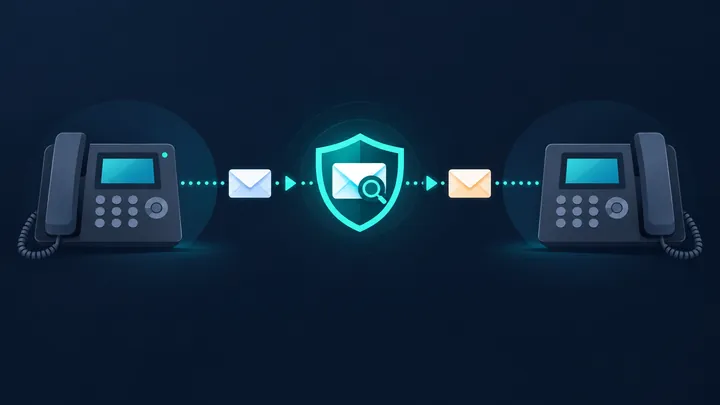
Good SIP security starts with deciding which messages your phone system should accept, rather than assuming every readable request deserves processing. SIP, the Session Initiation Protocol, tells systems where to send calls and when to establish sessions. Its text format helps engineers troubleshoot faults. But the same readable fields make requests easy to construct, inspect, and alter. Your controls need to follow those fields through the system.
Readable signaling needs explicit trust boundaries
Text isn't itself a vulnerability. The risk comes from trusting what that text claims. IETF RFC 3261 (2002), section 7 defines SIP messages as text-based; Wikipedia's SIP article (accessed 2026) explains their HTTP and SMTP influences. Names in headers aren't proof of identity.
Say a florist in Ottawa handles 300 calls daily. An INVITE claiming to come from its carrier may look familiar while arriving from an unrelated address. A rule that trusts the displayed caller or From header won't establish who sent it.
Keeping source admission, authenticated identity, and permitted actions separate makes your policy testable. VoIPshield, an Ottawa-based VoIP security company, builds tools for this distinction: VoIPguard provides VoIP-aware intrusion prevention with 250+ SIP/VoIP attack signatures. Protocol inspection complements access rules because an allowed sender can still submit a malicious request.
Port 5060 should reveal only your approved edge
An exposed SIP listener gives scanners a predictable place to send OPTIONS or REGISTER requests. Responses may reveal software details or account behavior. RFC 3261 (2002) specifies default port 5060 for UDP/TCP and 5061 for TLS over TCP; a different port doesn't establish trust.
Say a Leeds dental clinic has 40 handsets and two carrier signaling addresses. Its firewall forwards UDP 5060 directly to the private branch exchange (PBX), leaving strangers able to reach the call server.
- The inbound rule can allow only the carrier's documented signaling ranges to the session border controller (SBC), then deny other sources.
- Removing direct PBX port forwarding and binding its listener to an internal interface keeps external traffic at the inspected edge.
- Remote phones can use a VPN or an authenticated SBC service; dynamic home addresses shouldn't require exposing the PBX.
Equivalent IPv6 rules matter too. You'll need carrier failover ranges, or the restriction could break legitimate calls. These settings reduce reachability, not every attack from an approved peer.
An open registrar can redirect legitimate calls
The registrar maps a user's SIP address to a device location through REGISTER requests. If it accepts unauthenticated changes, another device can replace that destination. Authentication alone also isn't enough when one account can edit another account's mapping.
Say a Bristol repair business uses extension 204 for its booking desk. A registration that replaces 204's Contact address could route incoming bookings elsewhere without changing the published telephone number.
Setting registration authentication to required and guest registration to disabled closes anonymous updates. Authorization should bind each authenticated account to its own address of record, the stable SIP identity. RFC 3261 (2002), section 10.3, recommends this check and mandates rejection of unauthorized changes. An explicit local-domain list prevents unintended registrations for foreign domains.
A one-contact limit suits a desk phone, but it won't suit someone using both a handset and softphone. Matching contact limits to actual use restricts unwanted parallel registrations. A separate carrier trunk policy preserves legitimate inbound calls without granting registration rights.
Digest authentication doesn't encrypt SIP headers
Digest authentication uses a challenge-response exchange instead of sending the password directly. It doesn't encrypt signaling, and captured exchanges can expose weak passwords to offline guessing. RFC 3261 (2002), section 26.4.1, also explains that Digest doesn't protect the headers you may want secured.
Say a York wholesaler assigns password 204204 to extension 204. Keeping that secret off the wire won't make it resistant to guessing. Is switching to TLS enough? No: encryption doesn't repair a predictable credential.
A practical account policy uses unique, randomly generated secrets, for example 20 characters where supported. IETF RFC 8760 (2020) adds SHA-256 and SHA-512/256 to replace obsolete MD5. Selecting SHA-256 and disabling MD5 after endpoint compatibility testing removes that fallback; older handsets may need replacement.
Enabling qop=auth, nonce expiry, and nonce-count replay checks where supported limits reuse of captured authentication responses. Requiring TLS with certificate-chain and hostname validation protects signaling on that connection; disabling plaintext fallback prevents silent downgrade. Audio still needs separately configured Secure Real-time Transport Protocol (SRTP). Neither setting guarantees encryption beyond the participating hops.
INVITE floods consume state before a call connects
An INVITE can make a server allocate transaction state and forward requests before anyone answers. Floods exploit that work, not necessarily malformed syntax. RFC 3261 (2002), section 26.3.2.4, warns that message floods exhaust proxy resources and that stateful processing costs more.
Say a Manchester furniture shop normally receives at most two new call attempts per second. Its SBC could initially limit its carrier trunk to five new INVITEs per second with a ten-request burst, subject to testing. Those are illustrative settings, not universal safe limits.
Counting new transactions separately from retransmissions avoids treating normal UDP retries as extra calls. Per-source limits help with individual senders; aggregate limits cover distributed traffic. A concurrent-call cap prevents accepted traffic from consuming every trunk channel.
Stateless authentication challenges, where supported, reduce work for unauthenticated requests. Limits still need tests for transfers and busy-period surges. And an SBC can't recover an internet link already saturated by traffic; upstream filtering needs to be part of your provider agreement.
Authenticated input still needs validation
Allowed traffic can contain dangerous values. SIP fields may pass through parsers into databases, so transport security doesn't make those values safe. The VoIPshield Labs SES SIP SQL Injection advisory (2008) described valid credentials allowing arbitrary SQL commands inside a SIP request.
Say a Cardiff distributor retires an old call server but keeps its registrar component running. Strong passwords won't compensate for a vulnerable component that handles authenticated input unsafely.
The advisory's historical recommendation was SES 5.1 or later; that isn't a current secure-version recommendation. Supported releases and current security fixes address implementation flaws. SBC parser validation and tested message-size limits reduce malformed input reaching the server. For applications you control, parameterized database queries keep values separate from SQL instructions. Signature filtering is an interim barrier, not a substitute for fixes.
A rejected request is evidence; a failed call is not
A configuration can look secure while blocking your business. Rules need service tests as well as denial tests. Say the clinic's backup carrier connects from an omitted address: a quiet security dashboard would conceal a broken failover path.
Your acceptance tests should pair successful normal and failover calls with rejected anonymous registrations and cross-account updates. VoIPaudit's vulnerability assessment can support call-manager review; repeatable call tests check service behavior. Recording expected responses gives you evidence that each boundary rejects the wrong request without rejecting the right call.
Quick answers
Does SIP's text-based format make it insecure?
Text alone isn't a vulnerability. SIP security depends on validating message fields, authenticating senders, authorizing actions, and limiting exposure and processing.
Should port 5060 be open to the internet?
A PBX generally shouldn't be directly exposed. Approved carrier signaling can reach an SBC through restricted firewall rules, while remote phones use a VPN or authenticated edge service.
Does TLS replace digest authentication and input validation?
No. TLS protects signaling on a connection. Unique credentials, registration authorization, input validation, and security fixes address separate risks; SRTP protects audio separately.